
VLC147

In the heart of Naples, in via Luigi Caldieri, an apartment on the fifth floor of a residential building from the second half of the twentieth century is reborn thanks to an intervention that radically redefines its spaces.
Originally, the house followed a rather rigid distribution scheme: a sequence of rooms arranged along a long and identityless corridor.
The renovation project, developed starting from the needs of the new owner, overturns this approach, opening up the rooms, improving connections and restoring light, quality and breath to the entire apartment.
Through careful demolition and reconstruction work, the new planimetric system takes shape together with a system of custom-made furnishings that does not simply contain but becomes an integral part of the architecture, helping to define and shape the spaces.
VLC147
L'appartamento sorge al quinto piano di un edificio residenziale della seconda metà del Novecento, in Via Luigi Caldieri, a Napoli.
Il progetto di ristrutturazione modifica sostanzialmente la planimetria originale, realizzando una maggiore permeabilità tra gli ambienti, riducendo la presenza del corridoio e restituendo qualità al suo spazio.
La nuova configurazione spaziale è stata sviluppata utilizzando un sistema programmato di demolizioni e ricostruzioni murarie, supportato da un sistema di arredi strategicamente disegnati per avere una valenza non solo contenitiva ma soprattutto architettonica e spaziale.
VLC147
L'appartamento sorge al quinto piano di un edificio residenziale della seconda metà del Novecento, in Via Luigi Caldieri, a Napoli.
Il progetto di ristrutturazione modifica sostanzialmente la planimetria originale, realizzando una maggiore permeabilità tra gli ambienti, riducendo la presenza del corridoio e restituendo qualità al suo spazio.
La nuova configurazione spaziale è stata sviluppata utilizzando un sistema programmato di demolizioni e ricostruzioni murarie, supportato da un sistema di arredi strategicamente disegnati per avere una valenza non solo contenitiva ma soprattutto architettonica e spaziale.


The result is a home organized into two large areas, connected by a small hallway: on one side the living area, with kitchen and living room, on the other the sleeping area.
To separate them, a large equipped wall which is configured as a dynamic element capable, if necessary, of opening up and connecting the rooms, visually extending the space and creating unexpected connections between the living room, the guest bedroom and the path that leads to the master suite.

It is precisely this architectural device that constitutes the fulcrum of the project: an element that accompanies the transition from the living area to the sleeping area, restoring depth and character to the once anonymous distribution spaces.
The counterpoint in the living area is the volume of the kitchen island which, with its top covered in Vesuvian lava stone, highlights the Neapolitan roots of the project.

The strategic value of custom-made furnishings extends throughout the house: volumes and materials interact with the space, helping to define its character, brightness and atmosphere.

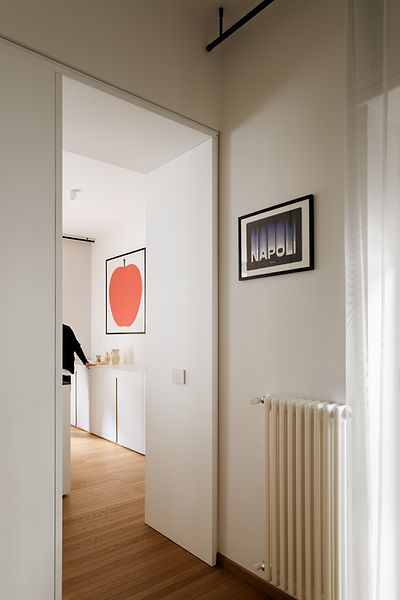


The continuity of the internal spaces is further strengthened by the widespread use of wooden flooring, with long and thin slats that, in addition to emphasizing the depth of the rooms, evoke the owner's passion for boating.


To complete the project, the curtains: light and functional, modulate the light and filter the relationship with the outside and the city, adding a final level of comfort and intimacy.

Before
